by Amazon.com Collection
Buy new:
(Visit the Best Sellers in list for authoritative information on this product's current rank.)
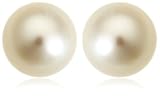
Frame your face in a radiant glow with these rare and stunning white South Sea pearl stud earrings. They showcase smooth, round natural white South Sea pearls, set on posts with clutch backings, both made from strong and radiant 14 karat white gold. The large 10-10.5mm pearls display a gorgeous high luster along with the natural flaws that convey their uniqueness and authenticity and contribute to their special allure. Their natural silvery white color seems to glow from within, and makes them a perfect complement to white gold and platinum jewelry.
The rare and exquisite South Sea pearl is a gem of exceptional beauty. South Sea pearls are cultivated inside the white-lipped variety of the pinctada maxima oyster. Grown and nurtured in the northern waters of Australia, the Philippines, and Indonesia, these oysters produce large round pearls with an unusually thick nacre, a high luster, and a distinctive silvery-white color. Because the process is time consuming (requiring at least two years for a single pearl) and because the oysters are highly sensitive to cultivation, South Sea pearls are rare and quite valuable. Noted for their size, smoothness, and lovely round shape, South Sea pearls make an extraordinary gift.

South Sea pearls are primarily cultured in the northern waters of Australia, the Philippines, and Indonesia. They are either white or black with silver overtones. Because of their size and high lustre, and the sensitivity of the oyster to culturing, they are quite valuable and rare. They average from 11-13mm, but can even be found as large as 20mm. The oyster that produces these pearls is considerably larger than those that produce Akoya pearls, and is extremely sensitive to the cultivation process. Gathering acceptable South Sea cultured pearls from these oysters is difficult, and makes them more expensive than Akoyas.
Cultivation
Pearls are produced naturally in the body of salt and freshwater mollusks, such as oysters and mussels. When these animals sense an irritant, such as a grain of sand, they produce a soft coating of calcium carbonate substance around it. The result is a pearl. Because perfectly round, naturally produced pearls are so rare, a process known as cultivation was developed by Kokichi Mikimoto in the early 1900s. A small bead of polished shell, the nucleus, is used as an irritant and delicately inserted into the mantle of a mollusk. It takes approximately 20-24 months of intensive husbandry to cultivate a saltwater pearl and somewhat less time to cultivate freshwater pearls. The harvest usually takes place during the months of June and September.
Color

Mollusks produce pearls in a variety of colors, accommodating most personal preferences and budgets. The general color of a pearl is also known as the body color. Pearls typically range from white, cream, and yellow to pink, silver, or black. An overtone of secondary color is sometimes seen. For instance, a pearl may appear to be white, but upon closer inspection a rosy hue is detected. The body color would then be termed white-rosé. Color variation does not affect the quality of the pearl, though it should be noted that color matching is important when choosing pearls for some necklaces, earrings, or bracelets. In fashion jewelry, pearls can sometimes be dyed to achieve the desired color, which should be mentioned in the product description or specifications.
Lustre
The appealing, deep shine of a pearl is often what defines its beauty. This shine is produced by multiple layers of semi-opaque calcium carbonate crystals, called nacre. The nacre reflects light on the surface of the pearl, producing brilliance and sheen. Lustre is an integral feature in determining the quality of a pearl. Large pearls have a thicker nacre and, therefore, a higher lustre. When comparing a small Freshwater pearl to a large South Sea pearl, the difference is clearly visible to the untrained eye and should be considered when purchasing pearls.
Shape
While pearls come in many different shapes, the rare
 st and highest-quality are round. Akoya, Tahitian, and South Sea oysters tend to produce the roundest pearls, while those of Freshwater mollusks can be oval to slightly off-round. When considering a pearl purchase, whether it be a necklace, bracelet, or earrings, look for consistency in the shapes of the pearls. Many of the less symmetrical shapes are used in stylish jewelry which can be quite beautiful: the drop pearl’s shape lends well to earrings, and the baroque pearl features irregular shapes that work well as necklace accents. In addition, a half sphere pearl called a “mabe” is often used in earrings, necklaces, and bracelets.
Size
An oyster’s particular type and size has a direct effect on how large the pearl it produces will be, and pearls do come in a wide range of sizes. Round pearls are measured according to their diameter, while baroque pearls are measured by their length and width. A pearl’s size does not necessarily affect its quality, but it does affect its price. Large, round pearls are rare and their lustre is usually high--this beautiful combination of traits is often reflected in the cost of such pearls.
Average pearl sizes (in diameter):
Akoya: 6-8mm
Freshwater: 5-6.5mm
South sea: 11-13mm
Tahitian: 11-12mm

Surface Markings
Often when an oyster creates a pearl, the nacre d
 oes not develop smoothly. The surface of a pearl is judged by how many marks are visible in the nacre. These imperfections can be small and unnoticeable or quite large and distinct. Like diamonds, pearls are rarely flawless. However, high lustre or the way pearls are strung and set can help conceal surface markings.
Care
Proper care of pearls is not difficult if you remember that they are organic and produced by a living thing. Pearls are soft and delicate, but when cared for with common sense, they will maintain their lustre for centuries. The pearls should not come in contact with cosmetics, hairspray, perfume, chlorinated water, or other harsh chemicals. To keep them clean, let them be the last item put on when dressing, and the first item taken off at the end of an evening. The best way to maintain their lustre is to wear the pearls often, and wipe them down with a soft cloth afterward--pearls absorb the oils from skin, which helps keep them moist. Pearls should be stored in a cloth pouch or jewelry bag, separated from other jewelry to prevent nicks or chipping. Periodically, pearl strands should be restrung since the silk thread used to tie the pearls together breaks down over time.


No comments:
Post a Comment